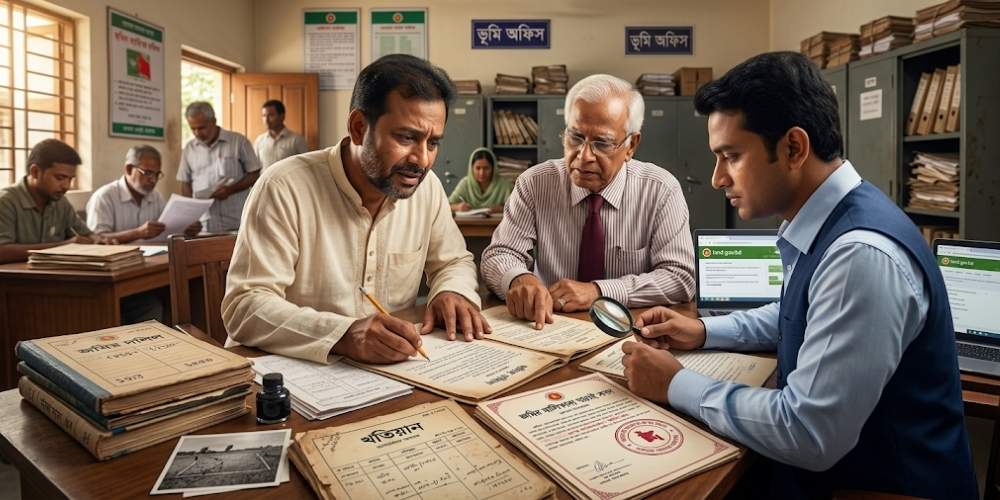
Buying land or an apartment is, for most families in Bangladesh, the single largest financial decision of their lives. It is also the area where disputes and fraud are most common. Forged deeds, sellers who do not actually own the property, plots sold to multiple buyers, and undisclosed mortgages or court injunctions account for a significant share of the civil litigation that clogs our courts. The good news is that the overwhelming majority of these problems are preventable. With careful verification before any money changes hands, a buyer can confirm exactly what is being sold, who is entitled to sell it, and whether the property is free of competing claims. This guide explains, in plain terms, the documents and checks that protect a purchaser under Bangladeshi law.
Understand the three core documents
Ownership of land in Bangladesh cannot be established from a single piece of paper. At a minimum, three categories of documents must be examined together and cross-checked against one another: the deed (dolil), the record of rights (khatian or porcha), and the mouza map (naksha). Each tells a different part of the story, and a gap or contradiction between them is the first warning sign of trouble.
The deed, or dolil, is the instrument that transfers ownership from one private party to another. There are many varieties — the Saf-Kabala (sale deed), Baya deed (prior chain deeds), Heba (gift deed), will deed, partition deed (bontonnama), and exchange deed (eoyaj), among others. The deed in the seller’s hands proves how they acquired the property. Equally important are the baya deeds: the chain of earlier transfers that shows the property passed cleanly through each previous owner down to the present seller. A break in this chain is a serious concern.
The khatian, also called the record of rights or porcha, is the government survey record that identifies who is recognised as the possessor and owner for the purposes of land development tax. Several survey series exist, and a thorough buyer should trace them in sequence: the CS (Cadastral Survey, the oldest), the SA (State Acquisition Survey), the RS (Revisional Survey), and the more recent BS or City Survey. Each survey should logically connect to the next. The mouza map shows the physical location, shape, and boundaries of the plot, allowing the buyer to confirm that the land described on paper matches the land on the ground.
Match the names — every time
The most important verification step is also the simplest: the name of the person selling the property must match the name recorded as owner in the khatian and must connect, through the chain of baya deeds, to the title the seller claims. If the khatian shows one name and the deed shows another, the discrepancy must be explained and documented — perhaps through an inheritance, a mutation, or a correction — before proceeding. A khatian reflects the current legal possessor according to the government survey, while a deed evidences a transfer between private parties; both must point to the same person. Never hand over money to a seller whose name does not appear in the official records or who cannot satisfactorily account for the difference.
Confirm mutation (namjari) has been completed
Mutation, known in Bengali as namjari, is the process of updating the owner’s name in the land revenue records after a purchase or inheritance. It is carried out at the local Assistant Commissioner (Land) office. Mutation matters because, without it, the buyer’s name will not appear in government records, and ownership remains incomplete in the eyes of the revenue authority even if a valid deed exists. When buying, confirm that the seller has completed mutation in their own name and holds the current mutation khatian and up-to-date land development tax (khajna) receipts. After your own purchase, applying promptly for mutation in your name is essential — it is the step that closes the loop and secures your position against later claims.
Search for encumbrances and disputes
A clean-looking deed does not guarantee a clean property. Before purchase, a prudent buyer or their lawyer should check whether the land is mortgaged to a bank, subject to a court injunction, under acquisition by the government, or already the subject of a pending suit. A non-encumbrance certificate obtained from the relevant Sub-Registrar’s office can reveal registered charges and prior registered transactions over a defined period. It is also wise to physically inspect the property, speak to neighbours and the local union or ward authorities, and confirm that the seller is actually in possession. Vacant possession claimed on paper but contradicted on the ground is a classic sign of a disputed or doubly-sold plot.
Beware the common fraud patterns
Several schemes recur often enough that every buyer should know them. The first is the forged or fabricated deed, where a fraudster produces an official-looking dolil for land they do not own. The second is the double sale, where the same plot is sold to two or more buyers, often with the second sale registered quickly to create confusion. The third is the power-of-attorney trap, where someone sells using a general power of attorney that has been revoked, forged, or never properly authorised. The fourth involves heirs: a seller may transfer property without the consent of co-heirs who hold an undivided share, leaving the buyer exposed to a partition suit. Verifying the chain of title, confirming the seller’s identity against the national ID, checking that any attorney holder has a valid and registered power, and ensuring all co-owners join the deed are the defences against each of these.
Register the deed properly
Under Bangladeshi law, a transfer of immovable property worth more than a nominal amount must be made by a registered instrument. Registration takes place at the office of the Sub-Registrar, and the law prescribes the stamp duty, registration fee, and other charges that must be paid. A sale that is not properly registered does not pass good title, no matter how much money was paid. At registration, ensure the deed accurately records the full consideration, the precise schedule of the property, the boundaries, and the share being transferred. Keep certified copies safely; they are your primary evidence of ownership.
When to involve a lawyer
While many buyers attempt verification on their own, the stakes and the complexity of land records in Bangladesh make professional due diligence a sound investment. A lawyer experienced in land and property matters can trace the chain of title across survey records, identify gaps that a layperson would miss, obtain and interpret non-encumbrance searches, draft a deed that protects the buyer, and ensure mutation is correctly applied for after purchase. Where the transaction involves inherited property, co-owners, agricultural land subject to ceiling rules, or property held by a company, expert review is not a luxury but a necessity.
A practical pre-purchase checklist
Before paying any deposit, a buyer should be able to answer yes to each of the following: Have I seen the original deed and the chain of baya deeds? Does the seller’s name match the latest khatian and mutation record? Are the land development tax receipts current? Does the mouza map match the physical plot and its boundaries? Has a non-encumbrance search been carried out? Have I confirmed the seller is in actual possession? If the property is inherited or co-owned, are all heirs and co-owners party to the sale? If any answer is no, the transaction should pause until the issue is resolved.
Verifying land ownership in Bangladesh is not a single act but a disciplined sequence of cross-checks. The buyer who insists on seeing the documents, matching the names, confirming mutation, and searching for encumbrances before paying is rarely the buyer who ends up in court. A modest investment of time and professional fees at the outset is the surest protection for a lifetime’s savings.